5  Phenology-Guided Deep Learning with Uncertainty Quantification for Soybean Yield Prediction

Run in Colab

Authors: Chishan Zhang, Chunyuan Diao

5.1 Overview

This notebook demonstrates the application of multiple deep learning models for crop yield estimation using satellite-derived time series data. The project showcases probabilistic modeling approaches that provide both predictions and uncertainty estimates for agricultural yield forecasting.

5.2 The Challenge with Current Yield Prediction Models

While deep learning has opened new possibilities for crop yield estimation, current approaches face two significant limitations. First, most models provide only deterministic predictions, ignoring the inherent uncertainties in agricultural systems—such as weather variability, satellite noise, and spatial heterogeneity. Without uncertainty quantification, the practical utility of these models for risk assessment is severely limited. # Second, existing models often rely on simple calendar-based aggregation (e.g., weekly or monthly averages). This approach fails to account for the biological reality of crop development, as the impact of environmental factors on yield varies substantially depending on the specific growth stage. To address these gaps, this notebook implements a phenology-guided, probabilistic deep learning framework that explicitly accounts for both temporal crop developmental stages and prediction uncertainties.

5.3 Model Architecture and Approaches

5.3.1 1. Probabilistic LSTM Model

  • Architecture: Long Short-Term Memory network with probabilistic output layer
  • Output: Mean and uncertainty estimates using Normal distribution
  • Loss Function: Negative Log-Likelihood (NLL)
  • Advantages:
    • Captures temporal dependencies in crop growth
    • Provides uncertainty quantification
    • Handles sequential nature of agricultural data

5.3.2 2. Probabilistic 1D-CNN Model

  • Architecture: Convolutional Neural Network for time series with probabilistic outputs
  • Layers: Multiple Conv1D layers with MaxPooling and Dense layers
  • Output: Mean and uncertainty estimates
  • Advantages:
    • Captures local temporal patterns
    • Efficient computation
    • Good for detecting seasonal patterns

5.3.3 3. Gaussian Process Regression (GPR)

  • Type: Bayesian non-parametric model
  • Kernel: RBF + White noise kernel with automatic hyperparameter optimization
  • Output: Mean predictions with uncertainty estimates
  • Advantages:
    • Natural uncertainty quantification
    • Flexible modeling assumptions
    • Works well with limited data

5.4 Key Functionalities

5.4.1 Data Preprocessing

  • Normalization: Z-score normalization using training data statistics
  • Missing Value Handling: NaN-aware statistical computations
  • Data Flattening: Conversion of time series to flat vectors for traditional ML models

5.4.2 Model Training and Evaluation

  • Train/Validation Split: 80/20 split with fixed random state
  • Early Stopping: Prevents overfitting in neural networks
  • Reproducibility: Fixed random seeds for consistent results
  • Cross-Model Comparison: Standardized evaluation metrics across all models

5.4.3 Uncertainty Quantification

  • Probabilistic Models: LSTM, CNN, and GPR provide prediction uncertainties
  • Confidence Intervals: 95% confidence interval coverage analysis
  • Uncertainty Visualization: Scatter plots with uncertainty bands

5.4.4 Feature and Temporal Importance Analysis

  • Permutation Importance: Identifies most influential input features
  • Phenological Analysis: Determines critical growth stages for yield prediction
  • Temporal Patterns: Visualizes importance across growing season

5.4.5 Spatial-Temporal Analysis

  • Multi-Year Evaluation: Model performance across different years (2018-2021)
  • Geographic Visualization: County-level prediction and uncertainty maps
  • Temporal Generalization: Tests model robustness across different growing seasons
"""
=== COMPREHENSIVE IMPORTS FOR CROP YIELD ESTIMATION NOTEBOOK ===

All required packages and dependencies for the entire notebook.
Place this cell near the top after the overview/description section.

Compatible Package Versions (tested and verified):
Python: 3.11.12
TensorFlow: 2.18.0
Keras (within TensorFlow): 3.8.0
TensorFlow Probability: 0.25.0
NumPy: 2.0.2
Pandas: 2.2.2
Scikit-learn: 1.6.1
Matplotlib: 3.10.0
Seaborn: 0.13.2
GeoPandas: 1.0.1
"""

# Standard Library Imports
import os
import sys
import time
import random
import warnings
import importlib.util

# Core Data Science Libraries
import numpy as np
import pandas as pd

# Visualization Libraries
import matplotlib.pyplot as plt
import seaborn as sns
from matplotlib.colors import LinearSegmentedColormap

# Machine Learning Libraries
from sklearn.model_selection import train_test_split
from sklearn.linear_model import LinearRegression
from sklearn.metrics import r2_score, mean_squared_error
from sklearn.ensemble import RandomForestRegressor
from sklearn.gaussian_process import GaussianProcessRegressor
from sklearn.gaussian_process.kernels import RBF, WhiteKernel, ConstantKernel as C

# Deep Learning Libraries
import tensorflow as tf
import tensorflow_probability as tfp
from tensorflow.keras.models import Sequential, load_model
from tensorflow.keras.layers import LSTM, Dense, Input, Conv1D, MaxPooling1D, Flatten, Dropout
from tensorflow.keras.callbacks import EarlyStopping

# Geospatial Libraries
try:
    import geopandas as gpd
    GEOPANDAS_AVAILABLE = True
    print("GeoPandas successfully imported")
except ImportError:
    GEOPANDAS_AVAILABLE = False
    print("GeoPandas not available - geographic visualizations will be skipped")

# TensorFlow Probability Distributions
tfd = tfp.distributions

# Suppress warnings for cleaner output
warnings.filterwarnings('ignore', category=FutureWarning)
warnings.filterwarnings('ignore', category=UserWarning, module='matplotlib')
warnings.filterwarnings('ignore', category=DeprecationWarning)
os.environ['TF_CPP_MIN_LOG_LEVEL'] = '2'  # Suppress TensorFlow warnings

# Configure TensorFlow for deterministic behavior
tf.config.experimental.enable_op_determinism()
physical_devices = tf.config.experimental.list_physical_devices('GPU')
if len(physical_devices) > 0:
    tf.config.experimental.set_memory_growth(physical_devices[0], True)

# Print Keras version
print(tf.keras.__version__)
# Google Drive mount is optional; skip when using local download_dir.
# If running in Colab with Drive storage, uncomment below:
# from google.colab import drive
# drive.mount('/content/drive')

5.5 1. Data Loading and Preprocessing

5.5.1 Study Area

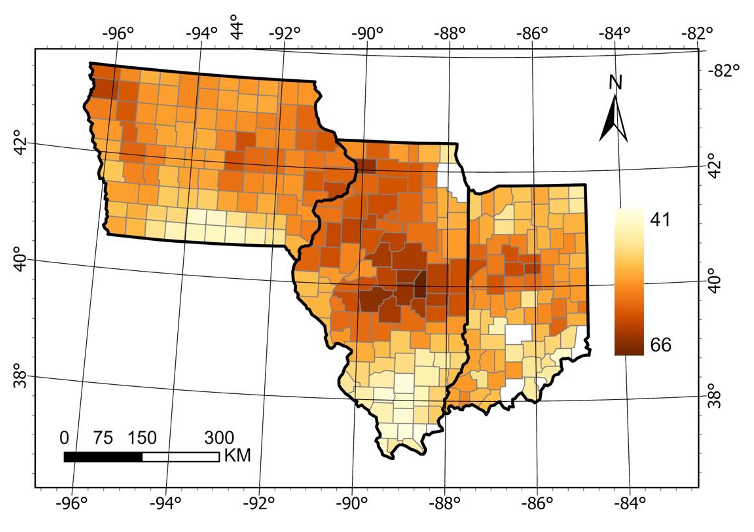
The study area includes the major soybean-producing states of Illinois, Indiana, and Iowa in the U.S. Corn Belt. County-level soybean yields (bu/ac) and phenology-guided predictors are analyzed for the period 2018–2021.

Study area map showing Illinois, Indiana, and Iowa with average soybean yields (bu/ac) from 2008 to 2021)

5.5.2 Dataset Overview

Data Download: The data can also be directly downloaded from: https://github.com/pouuh/phenology-guided-soybean-yield/releases/download/v1.0/soybean_phenology_guided_dataset.zip

This section loads the pre-processed satellite-derived time series data for soybean yield prediction. The dataset consists of:

  • Training Set: Multi-temporal observations from multiple growing seasons
  • Test Set: Holdout data for final model evaluation
  • Features: 14 environmental variables captured at regular intervals throughout the growing season
  • Target: County-level soybean yield measurements (bushels per acre)

5.5.3 Data Structure

  • Input Shape: (samples, timesteps, features) - 3D array representing time series
  • Temporal Resolution: Weekly to bi-weekly observations during growing season
  • Spatial Resolution: County-level aggregated values
  • Years Covered: 2018-2021 for model development and testing Loading

5.5.3.1 Input Features (X)

The input data for our models (X_train.npy, X_test.npy, [year]_X.npy) are time series with a shape of (samples, timesteps, features), where timesteps represent 6 phenological stages and features include 14 predictors:

  • EVI2 (Enhanced Vegetation Index 2):
    • Description: A satellite-derived measure of vegetation greenness and canopy health.
    • Significance for Yield: Higher EVI2 generally indicates a healthier, more photosynthetically active crop, which is essential for biomass accumulation and ultimately for producing higher yields through processes like pod development and seed fill. Stress events affecting EVI2 can signal potential yield reductions.
  • LST_Day (Daytime Land Surface Temperature in °C):
    • Description: The temperature of the ground surface during the day.
  • LST_Night (Nighttime Land Surface Temperature in °C):
    • Description: The temperature of the ground surface during the night.
  • tmax (Maximum daily air temperature in °C):
    • Description: Highest air temperature recorded in a day.
  • tmin (Minimum daily air temperature in °C):
    • Description: Lowest air temperature recorded in a day.
  • ppt (Precipitation in mm):
    • Description: Accumulated rainfall.
  • vpdmax & vpdmin (Maximum/Minimum Vapor Pressure Deficit in hPa):
    • Description: Measure of atmospheric dryness (the difference between how much moisture the air can hold and how much it actually holds).
  • Evap_tavg (Average Evapotranspiration in kg/m²/s or mm/day):
    • Description: Actual water loss from the soil surface (evaporation) and plant tissues (transpiration).
  • PotEvap_tavg (Average Potential Evapotranspiration in W/m² or mm/day):
    • Description: The amount of evapotranspiration that would occur if sufficient water were available.
  • SoilMoi0_10cm (Soil moisture at 0-10 cm depth in kg/m² or mm):
    • Description: Water content in the top soil.
  • SoilMoi10_40cm, SoilMoi40_100cm, SoilMoi100_200cm (Soil moisture at increasing depths):
    • Description: Water content in deeper soil layers.

5.5.3.2 Target Variable (Y)

The target variable for prediction (Y_train.npy, Y_test.npy) is: * County-Level Soybean Yield: * Unit: Bushels per acre (bu/ac). * Significance: This is the primary measure of agricultural productivity for soybeans. Accurate and timely yield prediction is crucial for farmers, policymakers, insurers, and commodity markets for planning, risk assessment, and economic forecasting.

# --- Automatic Data Download and Extraction ---
import urllib.request
import zipfile
import shutil

# Download URL
dataset_url = 'https://github.com/pouuh/phenology-guided-soybean-yield/releases/download/v1.0/soybean_phenology_guided_dataset.zip'
download_dir = './soybean_dataset'
zip_path = os.path.join(download_dir, 'dataset.zip')

# Create directory if it doesn't exist
os.makedirs(download_dir, exist_ok=True)

# Check if data already exists
required_files = ['X_train.npy', 'Y_train.npy', 'X_test.npy', 'Y_test.npy']
files_exist = all(os.path.exists(os.path.join(download_dir, file)) for file in required_files)

if not files_exist:
    print("Downloading soybean phenology guided dataset...")
    try:
        urllib.request.urlretrieve(dataset_url, zip_path)
        print(f"✓ Download completed: {zip_path}")
        
        print("Extracting dataset...")
        with zipfile.ZipFile(zip_path, 'r') as zip_ref:
            zip_ref.extractall(download_dir)
        print("✓ Extraction completed")
        
        # Remove zip file after extraction
        os.remove(zip_path)
        print("✓ Cleaned up zip file")
        
    except Exception as e:
        print(f"✗ Error downloading or extracting dataset: {e}")
        raise
else:
    print("✓ Dataset files already exist locally")

file_folder = download_dir + '/Soybean_Yield'

# Verify data files exist before loading
print("\nVerifying data files...")
for file in required_files:
    file_path = os.path.join(file_folder, file)
    if os.path.exists(file_path):
        print(f"✓ Found: {file}")
    else:
        print(f"✗ Missing: {file}")

# Load preprocessed time series data
print("\nLoading training and test datasets...")
X_train = np.load(os.path.join(file_folder, 'X_train.npy'))
Y_train = np.load(os.path.join(file_folder, 'Y_train.npy'))
X_test = np.load(os.path.join(file_folder, 'X_test.npy'))
Y_test = np.load(os.path.join(file_folder, 'Y_test.npy'))

print(f"Training data shape: X={X_train.shape}, Y={Y_train.shape}")
print(f"Test data shape: X={X_test.shape}, Y={Y_test.shape}")
print(f"Features per timestep: {X_train.shape[2]}")
print(f"Timesteps per sample: {X_train.shape[1]}")
# --- Displaying a sample of the input data (X_train) ---
print(f"Shape of X_train: {X_train.shape}") # Expected: (num_samples, 6 timesteps, 14 features)

if X_train.shape[0] > 0:
    print("\nFirst sample from X_train (all 6 timesteps, first 3 features shown for brevity):")
    # This prints the data for the first county-year, across all 6 phenological stages,
    # but only for the first 3 out of the 14 features to keep the printout manageable.
    # Adjust slicing as needed to show a meaningful snippet.
    print(X_train[0, :, :3])
else:
    print("X_train appears to be empty or not loaded correctly.")

5.5.4 Visualizing Input Feature Dynamics

To provide a more intuitive understanding of the input data (X) fed into our models, the plots below showcase the time series for three key predictors—EVI2, Maximum Temperature, and Precipitation—across the six phenological stages. These visualizations are for three randomly selected county-year samples from the training dataset and display the data in its [Specify: ‘original (pre-normalization)’ OR ‘normalized’] form.

Observing these plots helps to: * Illustrate the temporal patterns of different environmental variables through the defined soybean growth stages. * Appreciate the sample-to-sample variability in these predictors. * Better understand the nature of the 3D input (samples, timesteps, features) that the LSTM and 1D-CNN models process. Each line in a subplot represents the sequence of values for one feature across the 6 phenological stages (timesteps) for one sample.

data_to_sample_from = X_train
data_source_label = "Original (Pre-Normalization)" # Label for titles

# Define feature names and their indices within your 14 features.
# These MUST match the actual order in your X_train.npy features.
# Example (VERIFY AND UPDATE THESE INDICES BASED ON YOUR ACTUAL DATA):
feature_map = {
    'EVI2': 0,
    'LST_Day (K)': 1,
    'LST_Night (K)': 2,
    'Max Temperature (°C)': 3,  # Using tmax as an example temperature
    'Min Temperature (°C)': 4,
    'Precipitation (mm)': 5,
    'VPDmax (hPa)': 6,
    'VPDmin (hPa)': 7,
    'Evapotranspiration': 8,
    'Potential Evapotranspiration': 9,
    'SoilMoi0_10cm': 10,
    'SoilMoi10_40cm': 11,
    'SoilMoi40_100cm': 12,
    'SoilMoi100_200cm': 13
}

# Select features to plot (ensure these names match keys in feature_map)
features_to_plot_names = ['EVI2', 'Max Temperature (°C)', 'Precipitation (mm)']
selected_feature_indices = [feature_map[name] for name in features_to_plot_names]

num_samples_to_plot = 3
if data_to_sample_from.shape[0] >= num_samples_to_plot:
    # Set seed for reproducibility of random sample selection if desired
    # np.random.seed(42) # Optional: for consistent random samples
    random_indices = np.random.choice(data_to_sample_from.shape[0], num_samples_to_plot, replace=False)
else:
    print(f"Warning: Not enough samples in the dataset (found {data_to_sample_from.shape[0]}) to plot {num_samples_to_plot} unique samples.")
    random_indices = np.arange(min(num_samples_to_plot, data_to_sample_from.shape[0]))


if len(random_indices) > 0:
    num_stages = data_to_sample_from.shape[1] # Should be 6
    pheno_stages_labels = [f"Stage {i+1}" for i in range(num_stages)]

    fig, axes = plt.subplots(nrows=num_samples_to_plot, ncols=len(features_to_plot_names),
                             figsize=(18, 4 * num_samples_to_plot), sharex=False) # sharex=False might be better if scales differ

    # Adjust for single sample plotting case
    if num_samples_to_plot == 1:
        axes = np.array([axes]) # Make it 2D for consistent indexing

    fig.suptitle(f"Example Input Feature Time Series ({data_source_label} Data)", fontsize=18, y=1.03)

    for i, sample_idx in enumerate(random_indices):
        for j, feature_idx in enumerate(selected_feature_indices):
            ax = axes[i, j]
            time_series_data = data_to_sample_from[sample_idx, :, feature_idx]

            ax.plot(pheno_stages_labels, time_series_data, marker='o', linestyle='-')
            ax.set_ylabel(features_to_plot_names[j])
            if i == 0: # Set subplot titles for the first row (feature type)
                 ax.set_title(f"{features_to_plot_names[j].split(' (')[0]}")
            if j == 0: # Set y-axis title for the first column (sample identifier)
                 ax.text(-0.3, 0.5, f"Sample {i+1}", transform=ax.transAxes,
                         rotation=90, verticalalignment='center', fontsize=14)

            ax.grid(True, linestyle='--', alpha=0.7)
            ax.tick_params(axis='x', rotation=45)

    # Common X-label (optional, if sharex=True)
    # fig.text(0.5, 0.01, 'Phenological Stage', ha='center', va='center', fontsize=16)

    plt.tight_layout(rect=[0, 0.03, 1, 0.97]) # Adjust layout to make space for suptitle & xlabel
    plt.show()
else:
    print("No samples to plot.")
# === DATA NORMALIZATION FUNCTIONS ===
def normalize_data(data, mean, std):
    """
    Normalize time series data using z-score normalization.

    This function standardizes each feature across all samples and timesteps
    using the training set statistics to prevent data leakage.

    Parameters:
    -----------
    data : numpy.ndarray
        Input data of shape (samples, timesteps, features)
    mean : numpy.ndarray
        Feature-wise mean values from training data
    std : numpy.ndarray
        Feature-wise standard deviation from training data

    Returns:
    --------
    normalized_data : numpy.ndarray
        Z-score normalized data
    """
    # Prevent division by zero for constant features
    std_safe = std.copy()
    std_safe[std_safe == 0] = 1e-8

    normalized_data = (data - mean) / std_safe
    return normalized_data


# === COMPUTE NORMALIZATION STATISTICS ===
# Calculate feature-wise statistics from training data only
print("\nCalculating normalization statistics from training data...")
X_mean = np.nanmean(X_train, axis=(0, 1))  # Mean across samples and timesteps
X_std = np.nanstd(X_train, axis=(0, 1))    # Std across samples and timesteps

print(f"Features with zero variance: {np.sum(X_std == 0)}")
print(f"Features with NaN values: {np.sum(np.isnan(X_mean))}")

# Apply normalization to both training and test sets
print("Applying z-score normalization...")
X_train_normalized = normalize_data(X_train, X_mean, X_std)
X_test_normalized = normalize_data(X_test, X_mean, X_std)

# Update variables for consistency with rest of notebook
X_train = X_train_normalized
X_test = X_test_normalized

print("Data loading and preprocessing complete!")
print(f"Training data statistics: mean={np.nanmean(X_train):.3f}, std={np.nanstd(X_train):.3f}")
print(f"Test data statistics: mean={np.nanmean(X_test):.3f}, std={np.nanstd(X_test):.3f}")

5.6 Why Phenology-Guided Time Series Modeling?

Crop growth and yield formation are fundamentally governed by phenological development, not by fixed calendar dates. Environmental stresses such as heat, water deficit, or excessive moisture can have vastly different impacts on final yield depending on when they occur during the growing season. For example, stress during flowering or grain filling often has a disproportionately large effect compared to similar conditions during early vegetative growth.

Many existing yield prediction approaches rely on calendar-based temporal aggregation (e.g., weekly or monthly averages). While convenient, these fixed intervals may mix multiple developmental stages or split critical growth phases, thereby obscuring biologically meaningful signals.

In this notebook, we adopt a phenology-guided framework, where satellite- derived phenological transition dates are used to divide the growing season into six biologically meaningful stages. Environmental and vegetation predictors are aggregated within these adaptive stage boundaries, ensuring that the input time series aligns with actual crop development rather than arbitrary time windows. This approach improves both interpretability and the model’s ability to learn stage-specific yield sensitivities.

5.7 Why Quantify Prediction Uncertainty?

Crop yield prediction is inherently uncertain due to multiple sources of variability, including weather fluctuations, observation noise in remote sensing data, spatial heterogeneity in agricultural systems, and limitations in model structure. Deterministic point predictions alone do not convey how reliable a prediction is, which limits their usefulness for decision-making, risk assessment, and interpretation under atypical conditions.

To address this limitation, all models implemented in this notebook are formulated as probabilistic models, producing both a mean yield estimate and an associated uncertainty. These uncertainty estimates provide additional context about prediction confidence, highlighting conditions, regions, or yield ranges where the model is less certain. This is particularly important for applications such as agricultural monitoring, insurance, and climate risk assessment, where understanding prediction reliability is as critical as the prediction itself.

5.8 2. Model Development and Training

This section implements and compares three different approaches for probabilistic crop yield prediction:

  1. Probabilistic LSTM: Captures temporal dependencies in crop development
  2. Probabilistic 1D-CNN: Learns local temporal patterns and seasonal cycles
  3. Gaussian Process Regression (GPR): Provides natural uncertainty quantification

All models output both mean predictions and uncertainty estimates, enabling robust decision-making in agricultural applications.

5.8.1 Key Implementation Features:

  • Reproducible training: Fixed random seeds across all models
  • Early stopping: Prevents overfitting during neural network training
  • Validation split: 80/20 train/validation split for hyperparameter tuning
  • Probabilistic outputs: All models provide prediction uncertainty estimates

5.8.2 2.1 Probabilistic Long Short-Term Memory (LSTM) Model

Model Rationale: LSTM networks excel at modeling sequential data with long-term dependencies, making them ideal for crop yield prediction where: - Early season conditions influence late season development - Critical growth stages occur at different times - Weather patterns show temporal autocorrelation

Architecture Details: - Input Layer: Accepts time series of shape (timesteps, features) - LSTM Layer: 100 hidden units with built-in memory mechanisms - Dense Layers: 100-unit ReLU layer followed by 2-unit output - Probabilistic Output: Learns both mean (μ) and uncertainty (σ) parameters

Training Configuration: - Loss Function: Negative Log-Likelihood (NLL) for probabilistic training - Optimizer: Adam with learning rate 1e-4 - Batch Size: 64 samples - Early Stopping: Monitors validation loss with patience=10

# === PROBABILISTIC LSTM MODEL IMPLEMENTATION ===

# Split training data for validation
print("Creating train/validation split...")
X_train_split, X_val, Y_train_split, Y_val = train_test_split(
    X_train, Y_train,
    test_size=0.2,
    random_state=42,
    shuffle=True
)
print(f"Train samples: {X_train_split.shape[0]}, Validation samples: {X_val.shape[0]}")

# === PROBABILISTIC DISTRIBUTION SETUP ===

tfd = tfp.distributions

def normal_sp(params):
    """
    Create a Normal distribution from neural network outputs.

    This function transforms raw network outputs into a well-behaved
    probability distribution with learnable mean and variance.

    Parameters:
    -----------
    params : tf.Tensor
        Network output tensor with shape (batch_size, 2)
        First column: raw mean values
        Second column: raw scale parameters

    Returns:
    --------
    distribution : tfp.distributions.Normal
        Parameterized Normal distribution
    """
    return tfd.Normal(
        loc=params[:, 0:1],  # Mean parameter (no transformation)
        scale=1e-3 + tf.math.softplus(0.05 * params[:, 1:2])  # Ensure positive scale
    )

class ProbabilisticLayer(tf.keras.layers.Layer):
    """
    Custom Keras layer that outputs distribution parameters.

    This layer takes the raw outputs from the dense layer and
    formats them for probabilistic prediction.
    """
    def __init__(self, **kwargs):
        super().__init__(**kwargs)

    def call(self, inputs):
        """Transform inputs into distribution parameters."""
        dist = normal_sp(inputs)
        return tf.concat([dist.loc, dist.scale], axis=-1)

def NLL(y_true, y_pred):
    """
    Negative Log-Likelihood loss for probabilistic training.

    This loss function encourages the model to:
    1. Make accurate mean predictions
    2. Provide appropriate uncertainty estimates
    3. Avoid overconfident or underconfident predictions

    Parameters:
    -----------
    y_true : tf.Tensor
        True target values
    y_pred : tf.Tensor
        Predicted distribution parameters [mean, scale]

    Returns:
    --------
    nll : tf.Tensor
        Negative log-likelihood loss value
    """
    dist = tfd.Normal(
        loc=y_pred[:, 0:1],
        scale=y_pred[:, 1:2]
    )
    return -tf.reduce_mean(dist.log_prob(y_true))

# === REPRODUCIBILITY SETUP ===

def set_seeds(seed_value=32):
    """Set all random seeds for reproducible results."""
    os.environ['PYTHONHASHSEED'] = str(seed_value)
    random.seed(seed_value)
    np.random.seed(seed_value)
    tf.random.set_seed(seed_value)

def create_probabilistic_lstm(input_shape, lstm_units=100, dense_units=100):
    """
    Create a probabilistic LSTM model for yield prediction.

    Parameters:
    -----------
    input_shape : tuple
        Shape of input time series (timesteps, features)
    lstm_units : int
        Number of LSTM hidden units
    dense_units : int
        Number of dense layer units

    Returns:
    --------
    model : tf.keras.Model
        Compiled probabilistic LSTM model
    """
    model = Sequential([
        Input(shape=input_shape),
        LSTM(lstm_units, name='lstm_layer'),
        Dense(dense_units, activation='relu', name='dense_hidden'),
        Dense(2, name='distribution_params'),  # Output: [mean, scale]
        ProbabilisticLayer(name='probabilistic_output')
    ])

    model.compile(
        optimizer=tf.keras.optimizers.Adam(learning_rate=1e-4),
        loss=NLL,
        metrics=['mse']  # Additional metric for monitoring
    )

    return model

def train_and_evaluate_lstm(X_train_split, Y_train_split, X_val, Y_val, X_test, Y_test):
    """
    Complete training and evaluation pipeline for LSTM model.

    Parameters:
    -----------
    X_train, Y_train : numpy.ndarray
        Training data and labels
    X_val, Y_val : numpy.ndarray
        Validation data and labels
    X_test, Y_test : numpy.ndarray
        Test data and labels


    Returns:
    --------
    model : tf.keras.Model
        Trained model
    mean : numpy.ndarray
        Mean predictions for test data
    uncertainty : numpy.ndarray
        Uncertainty estimates for test data
    history : tf.keras.callbacks.History
        Training history
    """

    # Set seeds for reproducibility
    set_seeds()

    # Create model
    model = create_probabilistic_lstm(input_shape=(X_train_split.shape[1], X_train_split.shape[2]))

    # Define callbacks
    early_stopping = EarlyStopping(
        monitor='val_loss',
        patience=10,
        restore_best_weights=True,
        mode='min'
    )

    # Train the model
    history = model.fit(
        X_train_split, Y_train_split,
        epochs=1000,
        batch_size=64,
        validation_data=(X_val, Y_val),
        callbacks=[early_stopping],
        verbose=1
    )

    # Get predictions
    predictions = model.predict(X_test)
    means = predictions[:, 0]
    uncertainties = predictions[:, 1]

    # Calculate metrics
    final_r2 = r2_score(Y_test, means)
    final_rmse = np.sqrt(mean_squared_error(Y_test, means))

    print(f"\nFinal Test Metrics:")
    print(f"R2 Score: {final_r2:.4f}")
    print(f"RMSE: {final_rmse:.4f}")
    print(f"Average Uncertainty: {np.mean(uncertainties):.4f}")

    return model, means, uncertainties, history

# Execute LSTM training and evaluation
lstm_model, lstm_means, lstm_uncertainties, lstm_history = train_and_evaluate_lstm(
    X_train_split, Y_train_split,
    X_val, Y_val,
    X_test, Y_test
)
# --- Plotting Training and Validation Loss (Full and Zoomed Views) ---

# Ensure 'history' is the Keras History object from model.fit()

fig, axes = plt.subplots(nrows=1, ncols=2, figsize=(16, 6)) # Adjust figsize as needed

history = lstm_history

# Subplot 1: Full Training and Validation Loss Curve
axes[0].plot(history.history['loss'], label='Training NLL')
axes[0].plot(history.history['val_loss'], label='Validation NLL')
axes[0].set_title('Full Training & Validation Loss Curve')
axes[0].set_xlabel('Epoch')
axes[0].set_ylabel('NLL (Negative Log-Likelihood)')
axes[0].legend()
axes[0].grid(True, linestyle='--', alpha=0.6)

# Subplot 2: Zoomed-in View of Training and Validation Loss
start_epoch_for_zoom = 200  # Keep this or adjust if another start point is better
# Ensure there are enough epochs to make a zoomed plot meaningful
if len(history.history['loss']) > start_epoch_for_zoom:
    # X-axis range for the zoomed plot (actual epoch numbers)
    epoch_range_zoomed = range(start_epoch_for_zoom, len(history.history['loss']))

    axes[1].plot(epoch_range_zoomed,
                 history.history['loss'][start_epoch_for_zoom:],
                 label='Training NLL (Zoomed)')
    axes[1].plot(epoch_range_zoomed,
                 history.history['val_loss'][start_epoch_for_zoom:],
                 label='Validation NLL (Zoomed)')
    axes[1].set_title(f'Zoomed Loss (Epochs {start_epoch_for_zoom}+)')
    axes[1].set_xlabel('Epoch')
    axes[1].set_ylabel('NLL (Negative Log-Likelihood)')
    axes[1].legend()
    axes[1].grid(True, linestyle='--', alpha=0.6)
else:
    # Fallback if not enough epochs for the defined zoom
    axes[1].text(0.5, 0.5, 'Not enough epochs for zoomed view.',
                 horizontalalignment='center', verticalalignment='center',
                 transform=axes[1].transAxes)
    axes[1].set_title(f'Zoomed View (Epochs {start_epoch_for_zoom}+)')
    axes[1].set_xlabel('Epoch')
    axes[1].set_ylabel('NLL')


plt.tight_layout()
plt.show()
def evaluate_model(model, X_test, Y_test, model_name="Model"):
    """
    Comprehensive evaluation of a probabilistic model.

    Parameters:
    -----------
    model : tf.keras.Model or sklearn model
        Trained probabilistic model
    X_test, Y_test : numpy.ndarray
        Test data and labels
    model_name : str
        Name of the model for reporting

    Returns:
    --------
    predictions : numpy.ndarray
        Model predictions [mean, uncertainty]
    """
    predictions = model.predict(X_test)
    mean_pred = predictions[:, 0]
    std_pred = predictions[:, 1]

    # Calculate metrics
    final_r2 = r2_score(Y_test, mean_pred)
    final_rmse = np.sqrt(mean_squared_error(Y_test, mean_pred))

    print(f"\nFinal Test Metrics:")
    print(f"R2 Score: {final_r2:.4f}")
    print(f"RMSE: {final_rmse:.4f}")
    print(f"Mean Prediction Uncertainty: {np.mean(std_pred):.4f}")
    print(f"Min Uncertainty: {np.min(std_pred):.4f}")
    print(f"Max Uncertainty: {np.max(std_pred):.4f}")

    # Calculate prediction interval coverage
    within_interval = np.abs(Y_test - mean_pred) <= 2 * std_pred
    coverage = np.mean(within_interval) * 100
    print(f"95% CI Coverage: {coverage:.2f}%")

    return predictions

def plot_predictions_with_uncertainty(Y_test, predictions, title="Predictions with 95% Confidence Interval"):
    """
    Create publication-quality prediction vs truth plot with uncertainty visualization.

    Parameters:
    -----------
    Y_test : numpy.ndarray
        True target values
    predictions : numpy.ndarray
        Model predictions [mean, uncertainty]
    """
    mean_pred = predictions[:, 0]
    std_pred = predictions[:, 1]

    plt.figure(figsize=(8, 8))

    # Calculate overall min and max for consistent axes
    all_values = np.concatenate([Y_test.flatten(), mean_pred.flatten()])
    min_val = all_values.min()
    max_val = all_values.max()

    # Add some padding to the limits
    padding = (max_val - min_val) * 0.05
    axis_min = min_val - padding
    axis_max = max_val + padding

    # Sort for proper uncertainty band plotting
    sort_idx = np.argsort(Y_test.flatten())
    Y_test_sorted = Y_test.flatten()[sort_idx]
    mean_pred_sorted = mean_pred.flatten()[sort_idx]
    std_pred_sorted = std_pred.flatten()[sort_idx]

    # Plot uncertainty bands
    plt.fill_between(Y_test_sorted,
                    mean_pred_sorted - 2*std_pred_sorted,
                    mean_pred_sorted + 2*std_pred_sorted,
                    alpha=0.2, color='coral', label='95% CI')

    # Plot predictions
    plt.scatter(Y_test, mean_pred, alpha=0.5, color='cornflowerblue', label='Predictions')

    # Plot diagonal line
    plt.plot([Y_test.min(), Y_test.max()],
             [Y_test.min(), Y_test.max()],
             'r--', label='Perfect Prediction')

    # Calculate slope using linear regression
    lr = LinearRegression()
    lr.fit(Y_test.reshape(-1, 1), mean_pred)
    slope = lr.coef_[0]
    intercept = lr.intercept_
    r2 = r2_score(Y_test, mean_pred)

    # Plot fitted regression line
    plt.plot([axis_min, axis_max],
             [slope * axis_min + intercept, slope * axis_max + intercept],
             'g-', alpha=0.8, linewidth=2, label=f'Fitted Line (slope={slope:.2f})')

    # Set consistent square axes limits
    plt.xlim(axis_min, axis_max)
    plt.ylim(axis_min, axis_max)
    plt.gca().set_aspect('equal', adjustable='box')  # Make the plot square

    plt.xlabel('True Vaules (bu/ac)', fontsize=18)
    plt.ylabel('Predictions (bu/ac)', fontsize=18)
    plt.xticks(fontsize=16)
    plt.yticks(fontsize=16)
    plt.title(title, fontsize=20)
    plt.legend(fontsize=16, loc='upper left',frameon=False)
    # plt.grid(True, alpha=0.3)
    plt.tight_layout()
    plt.show()

# Evaluate LSTM model
predictions = evaluate_model(lstm_model, X_test, Y_test, model_name="LSTM")

# Visualize LSTM results
plot_predictions_with_uncertainty(Y_test, predictions)
# === MODEL PERSISTENCE ===

# Save the trained LSTM model for future use
model_save_path = os.path.join(file_folder, 'model_lstm.h5')
lstm_model.save(model_save_path)
print(f"LSTM model saved to: {model_save_path}")
print("Model can be loaded later using:")
print("  model = tf.keras.models.load_model(path, custom_objects={'ProbabilisticLayer': ProbabilisticLayer, 'NLL': NLL})")

5.8.3 2.2 Probabilistic 1D Convolutional Neural Network (CNN) Model

Model Rationale: 1D CNNs are particularly effective for time series analysis because they: - Detect local temporal patterns and seasonal cycles - Require fewer parameters than LSTM networks - Process data more efficiently for shorter sequences - Capture translation-invariant patterns across the growing season

Architecture Design: - Multi-scale Feature Extraction: Three convolutional blocks with different receptive fields - Hierarchical Learning: Filters progress from 32→32→16 to learn features at multiple scales - Pooling Strategy: MaxPooling reduces temporal dimension while preserving important features - Probabilistic Head: Same as LSTM - outputs mean and uncertainty estimates

Key Differences from LSTM: - Computational Efficiency: Faster training and inference - Local Pattern Focus: Better at detecting short-term temporal signatures - Parameter Efficiency: Fewer trainable parameters than equivalent LSTM - Parallel Processing: Convolutions can be parallelized more effectively


# === PROBABILISTIC 1D-CNN MODEL IMPLEMENTATION ===

def create_probabilistic_cnn(input_shape, filters=[32, 32, 16], kernel_size=3, dense_units=100):
    """
    Create a probabilistic 1D-CNN model for yield prediction.

    Parameters:
    -----------
    input_shape : tuple
        Shape of input time series (timesteps, features)
    filters : list
        Number of filters for each convolutional layer
    kernel_size : int
        Size of convolutional kernels
    dense_units : int
        Number of dense layer units

    Returns:
    --------
    model : tf.keras.Model
        Compiled probabilistic CNN model
    """
    model = Sequential([
        Input(shape=input_shape),

        # First convolutional block - captures fine-grained patterns
        Conv1D(filters=filters[0], kernel_size=kernel_size,
               activation='relu', padding='same', name='conv1d_1'),
        MaxPooling1D(pool_size=2, name='maxpool_1'),

        # Second convolutional block - learns mid-level features
        Conv1D(filters=filters[1], kernel_size=kernel_size,
               activation='relu', padding='same', name='conv1d_2'),
        MaxPooling1D(pool_size=2, name='maxpool_2'),

        # Third convolutional block - high-level temporal abstractions
        Conv1D(filters=filters[2], kernel_size=kernel_size,
               activation='relu', padding='same', name='conv1d_3'),

        # Flatten and dense layers
        Flatten(name='flatten'),
        Dense(dense_units, activation='relu', name='dense_hidden'),
        Dense(2, name='distribution_params'),
        ProbabilisticLayer(name='probabilistic_output')
    ])

    model.compile(
        optimizer=tf.keras.optimizers.Adam(learning_rate=1e-4),
        loss=NLL,
        metrics=['mse']
    )

    return model

def train_and_evaluate_cnn(X_train, Y_train, X_val, Y_val, X_test, Y_test):
    """
    Complete training and evaluation pipeline for CNN model.
    """
    set_seeds(132)

    print("Creating 1D-CNN model architecture...")
    model = create_probabilistic_cnn(
        input_shape=(X_train.shape[1], X_train.shape[2])
    )
    model.summary()

    # Define callbacks
    early_stopping = EarlyStopping(
        monitor='val_loss',
        patience=10,
        restore_best_weights=True,
        mode='min',
        verbose=1
    )

    print("\nStarting CNN training...")
    history = model.fit(
        X_train, Y_train,
        epochs=1000,
        batch_size=64,
        validation_data=(X_val, Y_val),
        callbacks=[early_stopping],
        verbose=1
    )

    print("\nEvaluating CNN on test set...")
    predictions = model.predict(X_test, verbose=0)
    mean_pred = predictions[:, 0]
    std_pred = predictions[:, 1]

    # Calculate performance metrics
    r2 = r2_score(Y_test, mean_pred)
    rmse = np.sqrt(mean_squared_error(Y_test, mean_pred))
    mae = np.mean(np.abs(Y_test.flatten() - mean_pred))

    print(f"\n=== CNN MODEL PERFORMANCE ===")
    print(f"R² Score: {r2:.4f}")
    print(f"RMSE: {rmse:.4f} bu/acre")
    print(f"MAE: {mae:.4f} bu/acre")
    print(f"Average Uncertainty: {np.mean(std_pred):.4f} bu/acre")
    print(f"Training completed in {len(history.history['loss'])} epochs")

    return model, predictions, history

# Execute CNN training and evaluation
cnn_model, cnn_predictions, cnn_history = train_and_evaluate_cnn(
    X_train_split, Y_train_split,
    X_val, Y_val,
    X_test, Y_test
)
# Save the trained CNN model
cnn_save_path = os.path.join(file_folder, 'model_cnn.h5')
cnn_model.save(cnn_save_path)
print(f"CNN model saved to: {cnn_save_path}")
# --- Plotting Training and Validation Loss (Full and Zoomed Views) ---

# Ensure 'history' is the Keras History object from model.fit()

fig, axes = plt.subplots(nrows=1, ncols=2, figsize=(16, 6)) # Adjust figsize as needed

history = cnn_history

# Subplot 1: Full Training and Validation Loss Curve
axes[0].plot(history.history['loss'], label='Training NLL')
axes[0].plot(history.history['val_loss'], label='Validation NLL')
axes[0].set_title('Full Training & Validation Loss Curve')
axes[0].set_xlabel('Epoch')
axes[0].set_ylabel('NLL (Negative Log-Likelihood)')
axes[0].legend()
axes[0].grid(True, linestyle='--', alpha=0.6)

# Subplot 2: Zoomed-in View of Training and Validation Loss
start_epoch_for_zoom = 200  # Keep this or adjust if another start point is better
# Ensure there are enough epochs to make a zoomed plot meaningful
if len(history.history['loss']) > start_epoch_for_zoom:
    # X-axis range for the zoomed plot (actual epoch numbers)
    epoch_range_zoomed = range(start_epoch_for_zoom, len(history.history['loss']))

    axes[1].plot(epoch_range_zoomed,
                 history.history['loss'][start_epoch_for_zoom:],
                 label='Training NLL (Zoomed)')
    axes[1].plot(epoch_range_zoomed,
                 history.history['val_loss'][start_epoch_for_zoom:],
                 label='Validation NLL (Zoomed)')
    axes[1].set_title(f'Zoomed Loss (Epochs {start_epoch_for_zoom}+)')
    axes[1].set_xlabel('Epoch')
    axes[1].set_ylabel('NLL (Negative Log-Likelihood)')
    axes[1].legend()
    axes[1].grid(True, linestyle='--', alpha=0.6)
else:
    # Fallback if not enough epochs for the defined zoom
    axes[1].text(0.5, 0.5, 'Not enough epochs for zoomed view.',
                 horizontalalignment='center', verticalalignment='center',
                 transform=axes[1].transAxes)
    axes[1].set_title(f'Zoomed View (Epochs {start_epoch_for_zoom}+)')
    axes[1].set_xlabel('Epoch')
    axes[1].set_ylabel('NLL')


plt.tight_layout()
plt.show()
# Evaluate CNN model
predictions = evaluate_model(cnn_model, X_test, Y_test, model_name="CNN")

# Visualize CNN results
plot_predictions_with_uncertainty(Y_test, predictions)

5.8.4 2.3 Gaussian Process Regression (GPR) Model

Model Rationale: Gaussian Processes provide a Bayesian approach to regression that: - Naturally quantifies uncertainty without architectural modifications - Works well with limited training data - Provides theoretical guarantees about uncertainty calibration - Serves as a strong baseline for comparison with neural networks

Key Advantages: - Natural Uncertainty: Uncertainty estimates are theoretically grounded - Non-parametric: Flexible model that adapts to data complexity - Interpretable: Kernel functions have clear mathematical meaning - Calibrated: Uncertainty estimates are typically well-calibrated

Implementation Notes: - Computational Complexity: O(n³) scaling requires subsampling for large datasets - Kernel Choice: RBF + White noise kernel for smooth trends with observation noise - Hyperparameter Optimization: Automatic optimization of kernel parameters - Data Preprocessing: Requires flattening of time series for traditional ML interface

### Gaussian Process Regression (GPR)
# Set random seed for reproducibility
seed_value=11
np.random.seed(seed_value)
random.seed(seed_value)

# Flatten the time series data for GPR
def flatten_time_series_data(X):
    """Flatten time series data for traditional ML models"""
    n_samples, n_timesteps, n_features = X.shape
    return X.reshape(n_samples, n_timesteps * n_features)

# Flatten training and test data
X_train_flat = flatten_time_series_data(X_train_split)
X_val_flat = flatten_time_series_data(X_val)
X_test_flat = flatten_time_series_data(X_test)

print(f"Original shape: {X_train_split.shape}")
print(f"Flattened shape: {X_train_flat.shape}")

# Due to computational constraints, we'll use a subset for GPR training
# GPR scales as O(n³) so we need to limit the training size
max_samples = 2000  # Adjust based on your computational resources
if X_train_flat.shape[0] > max_samples:
    print(f"Using subset of {max_samples} samples for GPR training")
    indices = np.random.choice(X_train_flat.shape[0], max_samples, replace=False)
    X_train_gpr = X_train_flat[indices]
    Y_train_gpr = Y_train_split[indices].ravel()
else:
    X_train_gpr = X_train_flat
    Y_train_gpr = Y_train_split.ravel()

# Define the kernel
# We use a combination of RBF (for smooth variations) and WhiteKernel (for noise)
kernel = C(1.0, (1e-3, 1e3)) * RBF(length_scale=1.0, length_scale_bounds=(1e-2, 1e2)) + WhiteKernel(noise_level=1.0, noise_level_bounds=(1e-10, 1e+1))

print("Creating Gaussian Process Regressor...")
gpr_model = GaussianProcessRegressor(
    kernel=kernel,
    alpha=1e-6,  # Small regularization parameter
    normalize_y=True,  # Normalize target values
    n_restarts_optimizer=5,  # Number of restarts for optimization
    random_state=seed_value,  # Set random seed for reproducibility
    # verbose=1  # Verbosity level
)

# Train the GPR model
print("Training Gaussian Process Regressor...")
start_time = time.time()
gpr_model.fit(X_train_gpr, Y_train_gpr)
training_time = time.time() - start_time
print(f"Training completed in {training_time:.2f} seconds")

print(f"Optimized kernel: {gpr_model.kernel_}")
print(f"Log-marginal-likelihood: {gpr_model.log_marginal_likelihood_value_:.3f}")
# Make predictions with uncertainty
print("Making predictions...")

# Predictions on training set (subset)
gpr_pred_train, gpr_std_train = gpr_model.predict(X_train_gpr, return_std=True)

# Predictions on validation set
gpr_pred_val, gpr_std_val = gpr_model.predict(X_val_flat, return_std=True)

# Predictions on test set
gpr_pred_test, gpr_std_test = gpr_model.predict(X_test_flat, return_std=True)

# Calculate metrics
train_r2 = r2_score(Y_train_gpr, gpr_pred_train)
train_rmse = np.sqrt(mean_squared_error(Y_train_gpr, gpr_pred_train))

val_r2 = r2_score(Y_val, gpr_pred_val)
val_rmse = np.sqrt(mean_squared_error(Y_val, gpr_pred_val))

test_r2 = r2_score(Y_test, gpr_pred_test)
test_rmse = np.sqrt(mean_squared_error(Y_test, gpr_pred_test))

# Print results
print(f"\nGaussian Process Regression Model Performance:")
print(f"Test - R²: {test_r2:.4f}, RMSE: {test_rmse:.4f}")
print(f"Average Test Uncertainty: {np.mean(gpr_std_test):.4f}")

# Calculate prediction interval coverage
within_interval = np.abs(Y_test.flatten() - gpr_pred_test) <= 2 * gpr_std_test
coverage = np.mean(within_interval) * 100
print(f"95% CI Coverage: {coverage:.2f}%")

# # Create scatter plot for GPR predictions
plot_predictions_with_uncertainty(Y_test, np.array([gpr_pred_test, gpr_std_test]).T)

5.9 3. Advanced Analysis and Interpretation

This section provides deeper insights into model behavior and practical applications:

5.9.1 3.1 Multi-Year Performance Analysis

  • Temporal Generalization: How well models perform across different years
  • Scatter Plot Analysis: Visual assessment of prediction quality by year
  • Annual Yield Trends: Comparison of predicted vs actual yield patterns

5.9.2 3.2 Feature and Temporal Importance

  • Permutation Importance: Identifies most influential environmental variables
  • Phenological Analysis: Determines critical growth stages for yield prediction
  • Agricultural Insights: Translates model behavior into agronomic understanding

5.9.3 3.3 Spatial-Temporal Visualization

  • Geographic Mapping: County-level prediction and uncertainty visualization
  • Uncertainty Patterns: Spatial distribution of model confidence
  • Temporal Consistency: Year-to-year prediction stability

5.9.4 3.1 Multi-Year Model Performance Analysis

This section evaluates how well our trained models generalize across different growing seasons and environmental conditions. By testing on individual years (2018-2021), we can:

  • Assess Temporal Robustness: How consistent are predictions across different weather years?
  • Identify Model Weaknesses: Which years or conditions challenge each model most?

Key Evaluation Aspects: - Year-by-Year Performance: R² and RMSE metrics for each test year - Visual Pattern Analysis: Scatter plots reveal model behavior and outliers

def plot_prediction_scatter(all_years_data, figsize=(20, 20)):
    """
    Create clean scatter plots of Predicted vs True Yield for each year with statistics
    """
    fig, axes = plt.subplots(2, 2, figsize=figsize)
    axes = axes.flatten()

    # Set font sizes
    plt.rcParams.update({
    'font.size': 28,           # Increased from 20
    'axes.labelsize': 30,      # Increased from 22
    'axes.titlesize': 32,      # Increased from 24
    'xtick.labelsize': 32,     # Increased from 20
    'ytick.labelsize': 32,     # Increased from 20
    })


    # Get overall min and max for consistent axes
    all_true = np.concatenate([data[0] for data in all_years_data.values()])
    all_pred = np.concatenate([data[1] for data in all_years_data.values()])
    min_val = min(all_true.min(), all_pred.min())
    max_val = max(all_true.max(), all_pred.max())

    for idx, year in enumerate(range(2018, 2022)):
        true_yield, pred_yield = all_years_data[year]
        ax = axes[idx]

        # Create scatter plot
        ax.scatter(true_yield, pred_yield,
                  alpha=0.6,
                  c='cornflowerblue',
                  s=100)

        # Calculate statistics
        r2 = r2_score(true_yield, pred_yield)
        rmse = np.sqrt(mean_squared_error(true_yield, pred_yield))

        # Add perfect prediction line
        ax.plot([min_val, max_val], [min_val, max_val],
                'r--', alpha=0.8)

        # Add labels and title
        ax.set_xlabel('True Yield (bu/ac)')
        ax.set_ylabel('Predicted Yield (bu/ac)')
        ax.set_title(f'Year {year}')

        # Set consistent axes limits
        ax.set_xlim(min_val, max_val)
        ax.set_ylim(min_val, max_val)

        # Add grid but make it lighter
        ax.grid(True, linestyle='--', alpha=0.3)

        # Remove frame
        ax.spines['top'].set_visible(False)
        ax.spines['right'].set_visible(False)

        # Add statistics text box without frame
        stats_text = f'RMSE: {rmse:.3f} bu/acre\nR²: {r2:.3f}'
        ax.text(0.05, 0.95, stats_text,
                transform=ax.transAxes,
                verticalalignment='top',
                fontsize=26,
                bbox=dict(facecolor='white',
                         edgecolor='none',
                         alpha=0.8,
                         pad=0.5))

    plt.tight_layout()
    return fig, axes
# load the lstm model again
model = create_probabilistic_lstm(input_shape=(X_train_split.shape[1], X_train_split.shape[2]))
model.summary()
with tf.keras.utils.custom_object_scope({
    'ProbabilisticLayer': ProbabilisticLayer,
    'NLL': NLL
}):
    model = load_model(os.path.join(file_folder, 'model_lstm.h5'))

# Load the county data
save_path = file_folder + '/'
df_all = pd.read_csv(save_path + '/Yield_2018_2021.csv')

# Collect data for all years
all_years_data = {}

for year in range(2018, 2022):
    # Load and process X data
    X_test = np.load(save_path + str(year) + '_X.npy')
    X_test = normalize_data(X_test, X_mean, X_std)

    # Get predictions
    predictions = model.predict(X_test)
    pred_yield = predictions[:, 0]

    # Get actual values
    df_year = df_all[df_all['Year'] == year]
    true_yield = df_year['Yield'].values

    # Store data
    all_years_data[year] = (true_yield, pred_yield)

# Create scatter plots
fig, axes = plot_prediction_scatter(all_years_data)
plt.show()
# load the CNN model again
model = create_probabilistic_cnn(input_shape=(X_train_split.shape[1], X_train_split.shape[2]))
model.summary()
with tf.keras.utils.custom_object_scope({
    'ProbabilisticLayer': ProbabilisticLayer,
    'NLL': NLL
}):
    model = load_model(os.path.join(file_folder, 'model_cnn.h5'))

# Load the county data
save_path = file_folder + '/'
df_all = pd.read_csv(save_path + '/Yield_2018_2021.csv')

# Collect data for all years
all_years_data = {}

for year in range(2018, 2022):
    # Load and process X data
    X_test = np.load(save_path + str(year) + '_X.npy')
    X_test = normalize_data(X_test, X_mean, X_std)

    # Get predictions
    predictions = model.predict(X_test)
    pred_yield = predictions[:, 0]

    # Get actual values
    df_year = df_all[df_all['Year'] == year]
    true_yield = df_year['Yield'].values

    # Store data
    all_years_data[year] = (true_yield, pred_yield)

# Create scatter plots
fig, axes = plot_prediction_scatter(all_years_data)
plt.show()

5.9.5 3.2 Feature Importance Analysis

Understanding which environmental variables most strongly influence crop yield predictions is crucial for:

Model Interpretation: - Validate Agricultural Knowledge: Confirm model learns biologically meaningful patterns - Identify Model Biases: Detect if model relies on spurious correlations - Guide Feature Engineering: Inform future data collection and preprocessing strategies

Scientific Understanding: - Quantify Variable Importance: Rank environmental factors by prediction contribution - Regional Adaptation: Understand which factors matter most in specific growing regions - Climate Change Impacts: Assess sensitivity to variables likely to change

Methodology:

We use permutation importance which measures how much model performance degrades when each feature is randomly shuffled, breaking its relationship with the target while preserving its distribution.

How the permutation_importance function works:

  1. Establish Baseline Performance:
    • First, the function calculates a baseline_score using a chosen evaluation metric (e.g., R² score) on the original, unaltered test dataset (X, y). This score represents the model’s performance when all features have their true values.
  2. Iterate Through Features:
    • The function then iterates through each input feature one by one (e.g., EVI2, LST_Day, specific soil moisture layers, etc.).
  3. Permute Feature Values:
    • For the current feature being evaluated, its values are randomly shuffled across all samples and all timesteps in a copy of the test dataset (X_permuted). This shuffling breaks the relationship between that feature and the target variable (y), effectively making the feature noisy or uninformative while keeping other features intact.
  4. Evaluate Performance with Permuted Feature:
    • The model then makes predictions using this X_permuted dataset (where one feature is shuffled).
    • A new performance score (permuted_score) is calculated using the same metric.
  5. Calculate Importance Score:
    • The importance of the feature for that single permutation run is the difference between the baseline_score and the permuted_score (i.e., baseline_score - permuted_score).
    • A significant drop in performance (a high positive importance score) after permuting a feature suggests that the model relied heavily on that feature for making accurate predictions. If the score does not change much, the feature is considered less important.
  6. Repeat for Robustness:
    • Steps 3-5 are repeated n_repeats times (e.g., 10 times by default) for each feature, with a new random permutation each time.
    • The average of these repeated importance scores is then taken as the final importance score for that feature. This averaging helps to provide a more stable and reliable estimate of feature importance.

The output is a list of importance scores, corresponding to each feature, indicating their relative contributions to the model’s predictive power on the given dataset and metric.

# load the whole data again
file_folder = download_dir + '/Soybean_Yield'
X_train = np.load(os.path.join(file_folder, 'X_train.npy'))
Y_train = np.load(os.path.join(file_folder, 'Y_train.npy'))
X_test = np.load(os.path.join(file_folder, 'X_test.npy'))
Y_test = np.load(os.path.join(file_folder, 'Y_test.npy'))

# Calculate mean and standard deviation
X_mean = np.nanmean(X_train, axis=(0, 1))
X_std = np.nanstd(X_train, axis=(0, 1))

# Normalize the data
X_train = normalize_data(X_train, X_mean, X_std)
X_test = normalize_data(X_test, X_mean, X_std)

# load the LSTM model
model = create_probabilistic_lstm(input_shape=(X_train_split.shape[1], X_train_split.shape[2]))
model.summary()

with tf.keras.utils.custom_object_scope({
    'ProbabilisticLayer': ProbabilisticLayer,
    'NLL': NLL
}):
    model = load_model(os.path.join(file_folder, 'model_lstm.h5'))
# Set professional plotting parameters
plt.rcParams.update({
    'font.family': 'serif',
    'font.serif': ['Times New Roman', 'DejaVu Serif'],
    'font.size': 10,
    'axes.labelsize': 11,
    'axes.titlesize': 12,
    'xtick.labelsize': 9,
    'ytick.labelsize': 9,
    'legend.fontsize': 9,
    'legend.title_fontsize': 10,
    'figure.dpi': 300,
    'savefig.dpi': 300,
    'savefig.bbox': 'tight',
    'savefig.pad_inches': 0.1
})

def permutation_importance(model, X, y, metric, feature_names, n_repeats=10):
    """
    Computes feature importance and its stability (standard deviation)
    using the permutation importance method for time-series data.

    The importance of a feature is determined by measuring the decrease in a model's
    performance score when that feature's values are randomly shuffled. A larger drop
    in score indicates higher importance. This process is repeated multiple times
    (n_repeats) for each feature to get a mean importance and its standard deviation.

    Parameters:
    ----------
    model : keras.Model
        The trained Keras model. Assumes model.predict(X)[:, 0] gives mean predictions.
    X : numpy.ndarray
        Input data (samples, timesteps, features).
    y : numpy.ndarray
        True target values.
    metric : function
        Performance metric function (e.g., r2_score).
    feature_names : list of str
        Names of the features.
    n_repeats : int, optional
        Number of times to repeat permutation for each feature. Default is 10.

    Returns:
    -------
    feature_names : list of str
        The original list of feature names.
    mean_importances : list of float
        Mean importance score for each feature.
    std_importances : list of float
        Standard deviation of importance scores for each feature across repeats.
    """
    # 1. Calculate the baseline performance score
    baseline_score = metric(y, model.predict(X)[:, 0])

    mean_importances = [] # To store mean importance score for each feature
    std_importances = []  # To store std dev of importance scores for each feature

    # 2. Iterate over each feature
    for feature_idx in range(X.shape[2]):
        scores_for_current_feature = [] # Scores from multiple permutations for this feature

        # 3. Repeat permutation n_repeats times for the current feature
        for _ in range(n_repeats):
            X_permuted = X.copy()

            # 4. Permute the current feature across all samples and timesteps
            permuted_values = np.random.permutation(X_permuted[:, :, feature_idx].flatten())

            # 5. Reshape and assign permuted values
            X_permuted[:, :, feature_idx] = permuted_values.reshape(X.shape[0], X.shape[1])

            # 6. Calculate score with permuted feature
            permuted_score = metric(y, model.predict(X_permuted)[:, 0])

            # 7. Importance is the drop in score
            scores_for_current_feature.append(baseline_score - permuted_score)

        # 8. Calculate mean and std dev of importances from n_repeats
        mean_importances.append(np.mean(scores_for_current_feature))
        std_importances.append(np.std(scores_for_current_feature))

    return feature_names, mean_importances, std_importances

# Define feature names (as in your provided code)
# Ensure this list matches the order and number of features in X_test correctly
non_soil_vars = ['EVI2','LST_Day','LST_Night','tmax',
                 'tmin','ppt', 'vpdmax','vpdmin','Evap_tavg',
                 'PotEvap_tavg','SoilMoi0_10cm', 'SoilMoi10_40cm',
                 'SoilMoi40_100cm','SoilMoi100_200cm']

# Calculate importance scores and standard deviations
# Assuming 'model', 'X_test', 'Y_test', 'r2_score' are defined
# This function now returns feature_names as the first element
# to maintain correspondence if you pass them in.
ordered_feature_names, mean_importance_scores, std_importance_scores = permutation_importance(
    model, X_test, Y_test, r2_score, non_soil_vars, n_repeats=10
)

# Combine for sorting based on mean importance scores
results_with_std = list(zip(ordered_feature_names, mean_importance_scores, std_importance_scores))
# Sort by mean importance score in descending order
results_with_std.sort(key=lambda x: x[1], reverse=True)

print("\nFeature Importance Rankings (Mean +/- Std Dev):")
for feature, score, std_dev in results_with_std:
    print(f"{feature:<30} importance: {score:.4f} +/- {std_dev:.4f}")

# Unzip for plotting (features will be in sorted order)
sorted_features, sorted_scores, sorted_stds = zip(*results_with_std)

# Create a bar plot with error bars
plt.figure(figsize=(14, 7)) # Adjusted figsize for better readability with error bars
bars = plt.bar(sorted_features, sorted_scores, yerr=sorted_stds,
               capsize=4, alpha=0.8, color='cornflowerblue', ecolor='black') # Added yerr and capsize

plt.xticks(rotation=45, ha='right', fontsize=14)
plt.yticks(fontsize=14)
plt.xlabel('Features', fontsize=16)
plt.ylabel('Importance Score (Decrease in R²)', fontsize=16) # Clarified y-axis
plt.title('Feature Importance Based on Permutation Test (with Stability)', fontsize=18)
plt.grid(True, axis='y', linestyle='--', alpha=0.7)
plt.tight_layout()
plt.show()

5.9.6 3.3 Phenological (Temporal) Importance Analysis

Understanding when during the growing season environmental conditions most strongly influence final yield is crucial for:

Scientific Understanding: - Phenological Insights: Validate known critical periods (flowering, grain filling) - Climate Sensitivity: Understand when crops are most vulnerable to weather stress - Yield Formation: Quantify relative importance of different developmental stages

Model Interpretation: - Temporal Attention: Understand which time periods the model focuses on - Seasonal Patterns: Identify consistent vs. variable importance across the season - Data Collection Priority: Guide decisions about temporal resolution of monitoring

Methodology: Instead of permuting individual features, we permute entire time steps, disrupting the temporal relationships while preserving the feature distributions at each time point.

def timestep_importance(model, X, y, metric, n_repeats=10):
    """
    Calculate importance scores for each time step using permutation importance.

    Parameters:
    -----------
    model : keras.Model
        Trained model
    X : numpy.ndarray
        Input data of shape (samples, timesteps, features)
    y : numpy.ndarray
        Target values
    metric : function
        Scoring metric (e.g., r2_score)
    n_repeats : int
        Number of times to repeat the permutation

    Returns:
    --------
    importances : list
        Importance score for each time step
    importances_std : list
        Standard deviation of importance scores for each time step
    timesteps : list
        List of time step indices
    """

    # Set random seed for reproducibility
    np.random.seed(32)

    baseline_score = metric(y, model.predict(X)[:, 0])
    importances = []
    importances_std = []
    timesteps = list(range(X.shape[1]))  # Get list of timestep indices

    # For each timestep
    for timestep_idx in range(X.shape[1]):
        scores = []
        for _ in range(n_repeats):
            X_permuted = X.copy()
            # Permute all features at this timestep
            permuted_values = np.random.permutation(X_permuted[:, timestep_idx, :])
            X_permuted[:, timestep_idx, :] = permuted_values
            permuted_score = metric(y, model.predict(X_permuted)[:, 0])
            scores.append(baseline_score - permuted_score)

        mean_score = np.mean(scores)
        std_score = np.std(scores)

        if mean_score > 0:
            importances.append(mean_score)
        else:
            importances.append(0)

        importances_std.append(std_score)

    return importances, importances_std, timesteps

def plot_timestep_importance(importances, importances_std, timesteps, window_size):
    """
    Plot timestep importance scores with error bars.

    Parameters:
    -----------
    importances : list
        Importance scores
    importances_std : list
        Standard deviation of importance scores
    timesteps : list
        Time step indices
    window_size : int
        Size of the input window in days
    """
    plt.figure(figsize=(8/1.5, 6/1.5))

    # Convert timestep indices to days before prediction
    days_before = [(window_size - i) for i in timesteps]

    plt.bar(days_before, importances, yerr=importances_std,
            # capsize=5, error_kw={'elinewidth': 2, 'alpha': 0.8})
            capsize=4, alpha=0.8, color='cornflowerblue', ecolor='black')
    plt.xlabel('Phenological Stage')
    plt.ylabel('Importance Score (decrease in R²)')
    plt.title('Phenological Stage Importance Based on Permutation Test')
    plt.grid(True, axis='y', linestyle='--', alpha=0.7)

    plt.tight_layout()
    plt.show()

def analyze_timestep_importance(model, X, y, window_size, metric=r2_score, n_repeats=10):
    """
    Analyze and visualize time step importance.

    Parameters:
    -----------
    model : keras.Model
        Trained model
    X : numpy.ndarray
        Input data
    y : numpy.ndarray
        Target values
    window_size : int
        Size of the input window in days
    metric : function
        Scoring metric (default: r2_score)
    n_repeats : int
        Number of permutation repeats (default: 10)
    """
    print("Calculating timestep importance scores...")
    importance_scores, importance_stds, timesteps = timestep_importance(model, X, y, metric, n_repeats)

    # Print results sorted by importance
    results = list(zip(timesteps, importance_scores, importance_stds))
    results.sort(key=lambda x: x[1], reverse=True)

    print("\nPhenology Stage Importance Rankings:")
    print("Phenology stage| Importance Score | Std Dev")
    print("-" * 55)
    for timestep, score, std in results:
        days_before = window_size - timestep
        print(f"{days_before:^19} | {score:>15.4f} | {std:>7.4f}")

    # Create visualization
    plot_timestep_importance(importance_scores, importance_stds, timesteps, window_size)

    return importance_scores, importance_stds, timesteps

window_size = X_train.shape[1]  # Your input window size
importance_scores, importance_stds, timesteps = analyze_timestep_importance(model, X_test, Y_test, window_size)

5.9.7 3.4 Spatial-Temporal Visualization and Uncertainty Mapping

This section provides geographic visualization of model predictions and uncertainties, enabling:

Spatial Pattern Analysis: - Regional Performance: How well does the model perform in different geographic areas? - Spatial Uncertainty Patterns: Are there geographic regions where the model is less confident? - Agricultural Zone Validation: Do predictions align with known agricultural productivity zones?

Temporal Consistency: - Year-to-Year Stability: How consistent are predictions across different growing seasons? - Climate Impact Visualization: Spatial patterns of model response to variable weather - Risk Assessment: Geographic identification of high-uncertainty areas for targeted monitoring

Visualization Features: - Choropleth Maps: County-level prediction and uncertainty visualization - Consistent Color Scales: Enable cross-year comparison - Uncertainty Quantification: Visual representation of model confidence

def get_overall_ranges(df_all, years_range):
    """Calculate min/max values for yield and uncertainty across all years."""
    all_predictions = []
    all_uncertainties = []

    for year in years_range:
        X_test = np.load(save_path + str(year) + '_X.npy')
        X_test = normalize_data(X_test, X_mean, X_std)
        predictions = model.predict(X_test)
        all_predictions.extend(predictions[:, 0])
        all_uncertainties.extend(predictions[:, 1])

    return {
        'yield_min': np.min(all_predictions),
        'yield_max': np.max(all_predictions),
        'uncertainty_min': np.min(all_uncertainties),
        'uncertainty_max': np.max(all_uncertainties)
    }

def plot_yield_prediction(counties, year, value_ranges, figsize=(8, 6), show_coords=True):
    """
    Create yield prediction map with less dense ticks
    """
    yield_colors = ['#f7fcf0', '#e0f3db', '#ccebc5', '#a8ddb5', '#7bccc4',
                   '#4eb3d3', '#2b8cbe', '#0868ac', '#084081']
    yield_cmap = LinearSegmentedColormap.from_list('yield_professional', yield_colors)

    fig, ax = plt.subplots(1, 1, figsize=figsize)

    # Plot counties
    counties.boundary.plot(ax=ax, linewidth=0.2, color='#666666', alpha=0.8)
    counties.plot(column='Predicted_Yield',
                 ax=ax,
                 cmap=yield_cmap,
                 vmin=value_ranges['yield_min'],
                 vmax=value_ranges['yield_max'],
                 edgecolor='none')

    if show_coords:
        bounds = counties.total_bounds
        ax.set_xlim(bounds[0], bounds[2])
        ax.set_ylim(bounds[1], bounds[3])

        # Create less dense coordinate ticks
        lon_range = bounds[2] - bounds[0]
        lat_range = bounds[3] - bounds[1]

        # Increase spacing for less dense ticks
        if lon_range > 20:
            lon_step = 5    # Changed from 2 to 5
            lat_step = 2    # Changed from 1 to 2
        elif lon_range > 10:
            lon_step = 3    # For medium areas
            lat_step = 2
        else:
            lon_step = 2    # For smaller areas
            lat_step = 1

        lon_ticks = np.arange(np.ceil(bounds[0]/lon_step)*lon_step, bounds[2], lon_step)
        lat_ticks = np.arange(np.ceil(bounds[1]/lat_step)*lat_step, bounds[3], lat_step)

        ax.set_xticks(lon_ticks)
        ax.set_yticks(lat_ticks)
        ax.set_xticklabels([f'{int(abs(x))}°W' for x in lon_ticks])
        ax.set_yticklabels([f'{int(y)}°N' for y in lat_ticks])

        ax.grid(True, alpha=0.3, linewidth=0.5, color='gray')
        ax.set_xlabel('Longitude')
        ax.set_ylabel('Latitude')
    else:
        ax.axis('off')

    # Add colorbar
    sm = plt.cm.ScalarMappable(cmap=yield_cmap,
                              norm=plt.Normalize(vmin=value_ranges['yield_min'],
                                               vmax=value_ranges['yield_max']))
    cbar = plt.colorbar(sm, ax=ax, shrink=0.8, aspect=30, pad=0.02)
    # cbar.set_label('Predicted Yield (bu/acre)', rotation=90, labelpad=15)

    ax.set_title(f'Predicted Crop Yield (bu/ac) - {year}', fontweight='bold', pad=15)

    return fig, ax

def plot_uncertainty(counties, year, value_ranges, figsize=(8, 6), show_coords=True):
    """
    Create uncertainty map with less dense ticks
    """
    uncertainty_colors = ['#053061', '#2166ac', '#4393c3', '#92c5de', '#d1e5f0',
                         '#f7f7f7', '#fddbc7', '#f4a582', '#d6604d', '#b2182b', '#67001f']
    uncertainty_cmap = LinearSegmentedColormap.from_list('uncertainty_professional', uncertainty_colors)

    fig, ax = plt.subplots(1, 1, figsize=figsize)

    # Plot counties
    counties.boundary.plot(ax=ax, linewidth=0.2, color='#666666', alpha=0.8)
    counties.plot(column='Uncertainty',
                 ax=ax,
                 cmap=uncertainty_cmap,
                 vmin=value_ranges['uncertainty_min'],
                 vmax=value_ranges['uncertainty_max'],
                 edgecolor='none')

    if show_coords:
        bounds = counties.total_bounds
        ax.set_xlim(bounds[0], bounds[2])
        ax.set_ylim(bounds[1], bounds[3])

        # Create less dense coordinate ticks (same logic as yield plot)
        lon_range = bounds[2] - bounds[0]
        lat_range = bounds[3] - bounds[1]

        if lon_range > 20:
            lon_step = 5    # Less dense
            lat_step = 2
        elif lon_range > 10:
            lon_step = 3
            lat_step = 2
        else:
            lon_step = 2
            lat_step = 1

        lon_ticks = np.arange(np.ceil(bounds[0]/lon_step)*lon_step, bounds[2], lon_step)
        lat_ticks = np.arange(np.ceil(bounds[1]/lat_step)*lat_step, bounds[3], lat_step)

        ax.set_xticks(lon_ticks)
        ax.set_yticks(lat_ticks)
        ax.set_xticklabels([f'{int(abs(x))}°W' for x in lon_ticks])
        ax.set_yticklabels([f'{int(y)}°N' for y in lat_ticks])

        ax.grid(True, alpha=0.3, linewidth=0.5, color='gray')
        ax.set_xlabel('Longitude')
        ax.set_ylabel('Latitude')
    else:
        ax.axis('off')

    # Add colorbar
    sm = plt.cm.ScalarMappable(cmap=uncertainty_cmap,
                              norm=plt.Normalize(vmin=value_ranges['uncertainty_min'],
                                               vmax=value_ranges['uncertainty_max']))
    cbar = plt.colorbar(sm, ax=ax, shrink=0.8, aspect=30, pad=0.02)
    # cbar.set_label('Prediction Uncertainty (bu/acre)', rotation=90, labelpad=15)

    ax.set_title(f'Prediction Uncertainty (bu/ac) - {year}', fontweight='bold', pad=15)

    return fig, ax


# Calculate overall ranges once
value_ranges = get_overall_ranges(df_all, range(2018, 2022))

# Create separate plots for each year
for year in range(2018, 2022):
    # Load the shapefile
    counties = gpd.read_file(save_path+'cb_2019_us_county_20m.shp')

    # Get data for current year
    df_year = df_all[df_all['Year'] == year]

    # Load and process X data
    X_test = np.load(save_path + str(year) + '_X.npy')
    X_test = normalize_data(X_test, X_mean, X_std)

    # Get predictions
    predictions = model.predict(X_test)
    mean_pred = predictions[:, 0]
    std_pred = predictions[:, 1]

    # Add predictions to dataframe
    df_year['Predicted_Yield'] = mean_pred
    df_year['Uncertainty'] = std_pred

    # Merge data
    df_year['GEOID'] = df_year['GEOID'].astype(str)
    counties['GEOID'] = counties['GEOID'].astype(str)
    counties = counties.merge(df_year, left_on='GEOID', right_on='GEOID')

    # Create and save yield prediction plot
    fig_yield, ax_yield = plot_yield_prediction(counties, year, value_ranges)
    # save_individual_figures(fig_yield, year, 'yield_prediction', save_path)
    plt.show()

    # Create and save uncertainty plot
    fig_uncertainty, ax_uncertainty = plot_uncertainty(counties, year, value_ranges)
    # save_individual_figures(fig_uncertainty, year, 'uncertainty', save_path)
    plt.show()

    # Close figures to save memory
    plt.close(fig_yield)
    plt.close(fig_uncertainty)
# Load the LSTM model
model = create_probabilistic_lstm(input_shape=(X_train_split.shape[1], X_train_split.shape[2]))
with tf.keras.utils.custom_object_scope({
    'ProbabilisticLayer': ProbabilisticLayer,
    'NLL': NLL
}):
    model = tf.keras.models.load_model(os.path.join(file_folder, 'model_lstm.h5'))

# Load the county data
save_path = file_folder + '/'
df_all = pd.read_csv(save_path + '/Yield_2018_2021.csv')

def plot_annual_average_yields_with_std():
    """
    Plot average actual vs predicted yields for each test year with standard deviation error bars
    """
    years = list(range(2018, 2022))
    avg_actual_yields = []
    avg_predicted_yields = []
    std_actual_yields = []
    std_predicted_yields = []

    # Calculate average and std yields for each year
    for year in years:
        # Load and process X data for the year
        X_test_year = np.load(save_path + str(year) + '_X.npy')
        X_test_year = normalize_data(X_test_year, X_mean, X_std)

        # Get predictions
        predictions = model.predict(X_test_year)
        pred_yield = predictions[:, 0]

        # Get actual yields for the year
        df_year = df_all[df_all['Year'] == year]
        true_yield = df_year['Yield'].values

        # Calculate averages and standard deviations
        avg_actual = np.mean(true_yield)
        avg_predicted = np.mean(pred_yield)
        std_actual = np.std(true_yield)
        std_predicted = np.std(pred_yield)

        avg_actual_yields.append(avg_actual)
        avg_predicted_yields.append(avg_predicted)
        std_actual_yields.append(std_actual)
        std_predicted_yields.append(std_predicted)

        print(f"Year {year}:")
        print(f"  Actual: {avg_actual:.2f} ± {std_actual:.2f} bu/ac")
        print(f"  Predicted: {avg_predicted:.2f} ± {std_predicted:.2f} bu/ac")

    # Create the plot
    plt.figure(figsize=(10, 6))

    # Plot both lines with error bars
    plt.errorbar(years, avg_actual_yields, yerr=std_actual_yields,
                 fmt='o-', linewidth=3, markersize=8, capsize=5, capthick=2,
                 color='darkblue', label='Actual Average Yield')
    plt.errorbar(years, avg_predicted_yields, yerr=std_predicted_yields,
                 fmt='s-', linewidth=3, markersize=8, capsize=5, capthick=2,
                 color='red', label='LSTM Predicted Average Yield')

    # Customize the plot
    plt.xlabel('Year', fontsize=14)
    plt.ylabel('Average Soybean Yield (bu/ac)', fontsize=14)
    plt.title('Average Actual vs LSTM-Predicted Soybean Yield(2018-2021)\nError bars show ± 1 standard deviation',
              fontsize=16, pad=20)

    # Set x-axis to show all years
    plt.xticks(years, fontsize=12)
    plt.yticks(fontsize=12)

    # Add grid for better readability
    plt.grid(True, alpha=0.3, linestyle='--')

    # Add legend
    plt.legend(fontsize=12, loc='best')

    # Set y-axis to start from a reasonable minimum
    all_values = avg_actual_yields + avg_predicted_yields
    all_stds = std_actual_yields + std_predicted_yields
    y_min = min(all_values) - max(all_stds) - 2
    y_max = max(all_values) + max(all_stds) + 2
    plt.ylim(y_min, y_max)

    # Tight layout to prevent label cutoff
    plt.tight_layout()

    # Show the plot
    plt.show()

    # Calculate and print overall statistics
    mae = np.mean(np.abs(np.array(avg_actual_yields) - np.array(avg_predicted_yields)))
    rmse = np.sqrt(np.mean((np.array(avg_actual_yields) - np.array(avg_predicted_yields))**2))
    r2 = r2_score(avg_actual_yields, avg_predicted_yields)

    print(f"\nOverall Performance Metrics (Annual Averages):")
    print(f"MAE: {mae:.2f} bu/ac")
    print(f"RMSE: {rmse:.2f} bu/ac")
    print(f"R²: {r2:.3f}")

    # Print standard deviation comparison
    print(f"\nStandard Deviation Comparison:")
    print(f"Average Std of Actual Yields: {np.mean(std_actual_yields):.2f} bu/ac")
    print(f"Average Std of Predicted Yields: {np.mean(std_predicted_yields):.2f} bu/ac")

    return years, avg_actual_yields, avg_predicted_yields, std_actual_yields, std_predicted_yields

# Create the plot with standard deviations
years, actual_yields, predicted_yields, std_actual, std_predicted = plot_annual_average_yields_with_std()

5.10 Conclusions and Limitations

This notebook demonstrated a phenology-guided, probabilistic deep learning workflow for soybean yield prediction using satellite-derived time series and environmental data. By aligning predictors with crop developmental stages and employing probabilistic LSTM, 1D-CNN, and Gaussian Process models, the approach captures both temporal yield dynamics and associated prediction uncertainty. Results highlight the dominant role of vegetation condition (EVI2), shallow soil moisture, and late-season phenological stages in determining final yield.

Several limitations should be noted. The analysis is conducted at the county level and does not explicitly incorporate detailed management information such as planting dates, cultivar maturity groups, or within-county variability. Additionally, while probabilistic outputs are provided, uncertainty estimates are primarily aleatoric and would benefit from further calibration and the explicit inclusion of epistemic uncertainty. Readers are referred to the accompanying book chapter for a more detailed discussion of results, interpretation, and methodological considerations.

5.11 Looking Forward: Future Directions and Next Steps

This notebook has walked through a phenology‑guided deep learning pipeline for soybean yield prediction, including probabilistic modeling of prediction uncertainty. If you are relatively new to deep learning in agriculture, being able to train a time‑series model that predicts yield and provides its own uncertainty estimates is already a significant step.

As discussed in the limitations and future directions of the chapter, this framework is meant to serve as a foundation rather than an endpoint. When adapting these ideas to your own work, you might consider the following directions:

  • Exploring Advanced Time Series Architectures: You can experiment by varying the current LSTM architecture (e.g., adjusting the number of layers, units, or regularization) to observe how model complexity impacts performance and overfitting. Additionally, consider comparing the LSTM against other sequence models like Gated Recurrent Units (GRUs) or modern Attention/Transformer-based architectures. As an analytical exercise, you might also investigate early-season forecasting by training models using only the first few phenological stages to determine exactly when reliable yield signals first emerge.
  • Expanding Phenology Applications: The satellite-derived phenology approach used here is highly adaptable. You can modify this pipeline to study different crops (such as corn or wheat) by swapping the MODIS transition dates, or test the integration of specific extreme weather proxies, like heat-stress degree days or drought indices.
  • Deepening Uncertainty Quantification (UQ): The probabilistic models in this notebook output a mean and variance to capture aleatoric uncertainty (inherent noise in the data). A powerful next step is to explore epistemic uncertainty (uncertainty in the model’s own knowledge). You could try implementing Deep Ensembles (training multiple models and combining their predictive distributions) or exploring Bayesian Neural Networks (e.g., using TensorFlow Probability) to generate even more robust, trustworthy confidence intervals for decision-makers.

Ultimately, the goal of these tools is to align with initiatives like the NASA Earth Science to Action framework—translating raw satellite data into actionable agricultural insights. We encourage you to adapt this code to your own local regions and continue exploring how machine learning can support sustainable, climate-resilient agriculture!